Introduction
Ordering bulk second hand summer and winter clothing bales is one of the most common ways importers fill a container, and one of the easiest to get wrong. A container packed mostly with T-shirts and shorts will disappoint a buyer serving a cold market, while a winter-heavy load will sit unsold in a warm one. The season ratio is not a detail; it is the product.
A buyer in Bolivia once ordered a mixed container and asked for “good quality clothes” without specifying the season split. The load arrived heavy with lightweight summer pieces, just as the cooler months began. The garments were clean and well sorted, but they were the wrong product for the next three months of selling.
This guide explains how to buy bulk second hand summer and winter clothing bales: how the two seasons differ, how to match bales to your market, how to plan weight and piece count, how to calculate revenue per bale, and how to verify the supplier’s season sorting. Zagumi figures are company information, while general market observations are guidance and may vary by destination.
1. The First Buying Decision: Season Balance
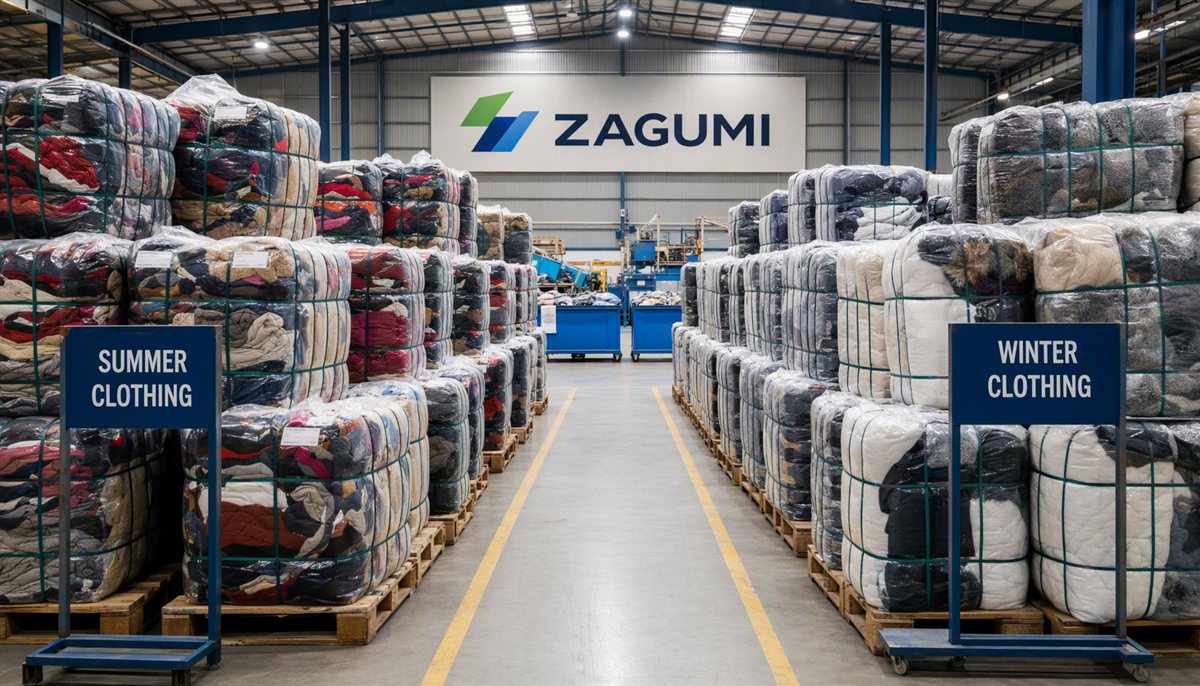
The season balance decides most of the commercial outcome of a bale order. It affects what you can sell, how fast you can sell it, and how much storage you need.
Two buyers can order from the same supplier and get completely different results purely because of the season mix. A wholesaler in Ghana serving open markets may want 80% summer clothing and 20% light winter pieces for cooler evenings. A distributor in Central Asia may reverse the ratio. Neither buyer is wrong; each is matching the product to the market.
The season balance should be written into the order in two forms: by weight and by piece count. These are not the same. Winter garments such as jackets and heavy denim weigh much more than summer tops, so a load that is 50% winter by weight can contain far fewer winter pieces than the buyer expects.
A good bulk second hand clothes supplier will confirm the season ratio in writing before production, but the buyer still needs to define that ratio first. Before ordering bulk second hand summer and winter clothing bales, answer these questions:
- What is the average temperature range in the main selling months?
- How long does each season last?
- Which customer group is buying: market shoppers, stores, or online buyers?
- Is there a strong second season, such as a short cool period or a rainy season?
- How much storage and display space do you have?
- What is your past sell-through by season, if you have data?
A retailer in Peru kept records for two years and discovered that lightweight cotton sold year-round but that heavy outerwear only moved for eight weeks. The next order reduced the winter share and increased denim and shirts. The change was based on sales records, not on a generic regional assumption.
Action steps
- Set the season ratio in writing before requesting quotes.
- Express the ratio in both weight and estimated pieces.
- Review local weather patterns and past sales data.
- Ask the supplier to confirm whether the ratio is a target or a guarantee.
2. Summer Bales vs Winter Bales: Contents and Grading
Summer and winter bales are different products, and the difference is not only about fabric weight. Sorting, grading, and the useful categories inside each bale type follow the season.
| Bale type | Typical contents | Key inspection points | Common buyer risk |
|---|---|---|---|
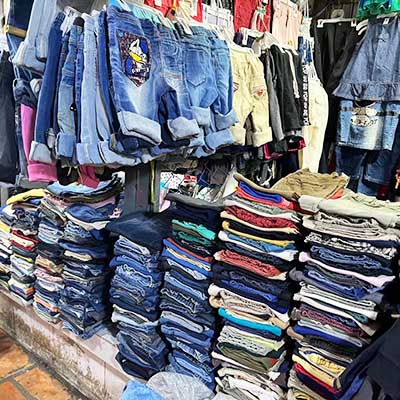
| Summer bales | T-shirts, blouses, shorts, light dresses, skirts | Stains, collar wear, sun damage, thinning fabric | High quantity but uneven resale value |
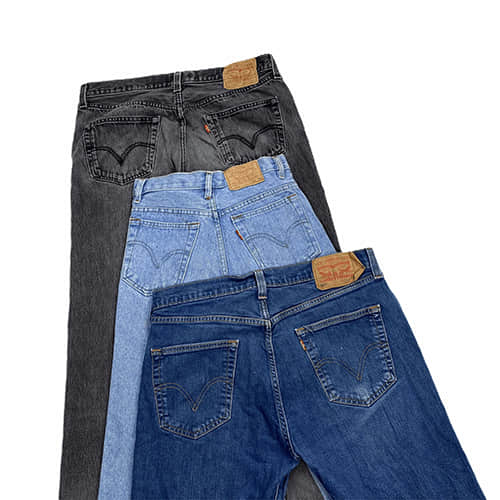
| Winter bales | Sweaters, jackets, coats, hoodies, heavy denim | Zippers, lining, insulation, buttons, moth damage | High weight and slow turnover in warm markets |
| Mixed season bales | A controlled share of both seasons | Season ratio accuracy, labeling | Ratio imbalance after loading |
| Premium season bales | Higher-grade pieces in one season | Brand relevance, fashion currency | Paying a premium for limited demand |
Buyers shopping for summer used clothing bales wholesale should expect more lightweight items and a higher piece count per weight. Buyers looking for winter second hand clothing bales should expect heavier bales, fewer pieces per kilogram, and more categories such as sweaters and outerwear.
A first-time importer in Paraguay ordered winter second hand clothing bales for a market where cold weather is short. The bales were well graded and clean, but the buyer had overestimated how many heavy items the local market could absorb. The result was discounted sales and slow cash flow, even though the product quality was acceptable.
The same discipline applies to mixed season clothing bales. “Mixed” should be defined by a written ratio, not left to the supplier’s interpretation. Ask whether the season split is controlled by weight, by bale, or by piece count, and request the same definition from every supplier you compare.
Action steps
- Request a category list inside each season bale type.
- Define the season split as a written ratio.
- Compare two suppliers’ season bale definitions side by side.
- Confirm what happens if the actual ratio differs from the order.
3. Match Season Bales to Your Market and Climate
Market matching is where the buyer’s knowledge adds the most value. The same bale can be a best-seller in one country and dead stock in another.
| Market type | Recommended season mix | Strongest categories | Main seasonal risk |
|---|---|---|---|
| Warm, year-round market | 80% summer, 20% light winter | T-shirts, shorts, light dresses | Heavy winter surplus |
| Short cool season | 60% summer, 40% transitional | Light denim, hoodies, jackets | Wrong timing of winter goods |
| Long cold season | 25% summer, 75% winter | Sweaters, coats, thermal wear | Excess light garments |
| Dual season, large temperature range | 50% each | Balanced by month | Storage between seasons |
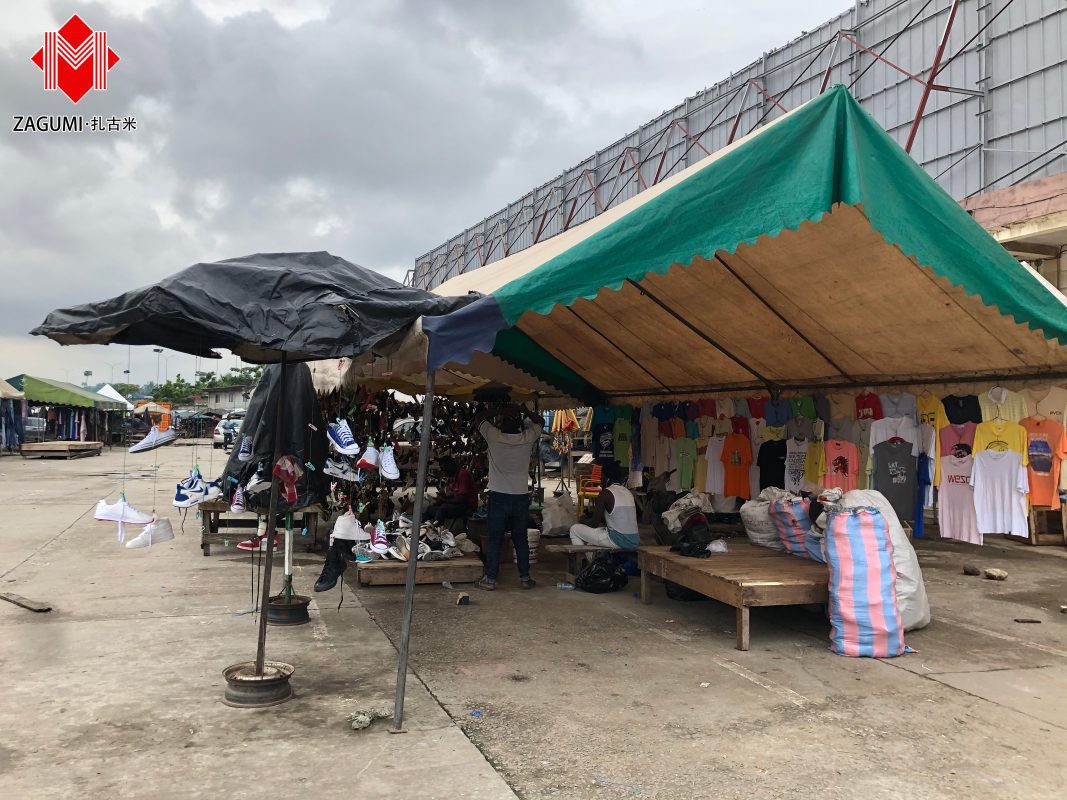
A buyer in Senegal ordered mixed season clothing bales with 70% summer and 30% light transitional pieces. The transitional share gave the buyer flexibility during the short cooler months without tying up cash in heavy stock. A buyer in a colder region would reasonably choose the opposite balance. For warm markets, summer used clothing bales wholesale are usually the higher-volume, faster-turnover option.
The market comparison above is a planning guide based on common patterns, not a guaranteed formula. Buyers should verify against local sales data, climate records, and competitor assortments.
Timing also matters. Clothing for a cool season should arrive one to two months before the season starts, because local sorting and distribution take time. Winter second hand clothing bales should arrive before the cool season, not during it. A buyer who receives winter bales in the middle of the cold months has already missed a large share of demand.
Action steps
- Match the season ratio to the actual selling calendar.
- Plan arrival dates around the start of each season.
- Include transitional categories to reduce risk.
- Check what competing sellers are carrying in the same market.
4. Weight vs Piece Count: Planning a Mixed Season Load
Weight and piece count measure different things, and both are needed to plan a profitable load. This is one of the most common sources of confusion in seasonal bale ordering.
A 45 kg bale of winter sweaters may hold only 35 to 45 pieces, while a 45 kg bale of summer T-shirts may hold 80 to 100 pieces. If the buyer plans the order by weight only, the piece count will be dominated by the lighter category, which may not be the category the market needs.
A practical planning table shows the difference:
| Category | Approximate pieces per 45 kg | Estimated weight per piece | Planning use |
|---|---|---|---|
| Summer T-shirts | 90–110 | 0.4–0.5 kg | High piece count, fast turnover |
| Light blouses and dresses | 60–80 | 0.55–0.7 kg | Mid-range piece count |
| Light denim and chinos | 45–60 | 0.7–0.9 kg | Good value balance |
| Sweaters | 35–45 | 1.0–1.3 kg | Heavy, slower turnover |
| Jackets and coats | 20–30 | 1.5–2.2 kg | Highest weight, highest selling price |
These figures are illustrative ranges, not a guaranteed standard for every supplier. Use them to test whether a quotation is consistent with a realistic piece count.
A buyer in Kenya once accepted a “50% summer, 50% winter” ratio expressed by weight. Because winter items weigh more, the actual piece count was closer to 30% winter pieces. The buyer had planned retail stock on the basis of the winter share and had to adjust pricing after arrival.
The solution is to ask for the ratio in both measurements. Use piece count for retail and category planning, and weight for freight, bale count, and container loading. Both numbers should appear in the packing list.
Action steps
- Request the season and category ratio by weight and by piece.
- Ask the supplier for an estimated piece count per bale type.
- Convert your retail demand into a piece-count target before ordering.
- Check that the packing list shows both weight and piece data.
5. Deep Analysis: Revenue per Bale Across Seasons
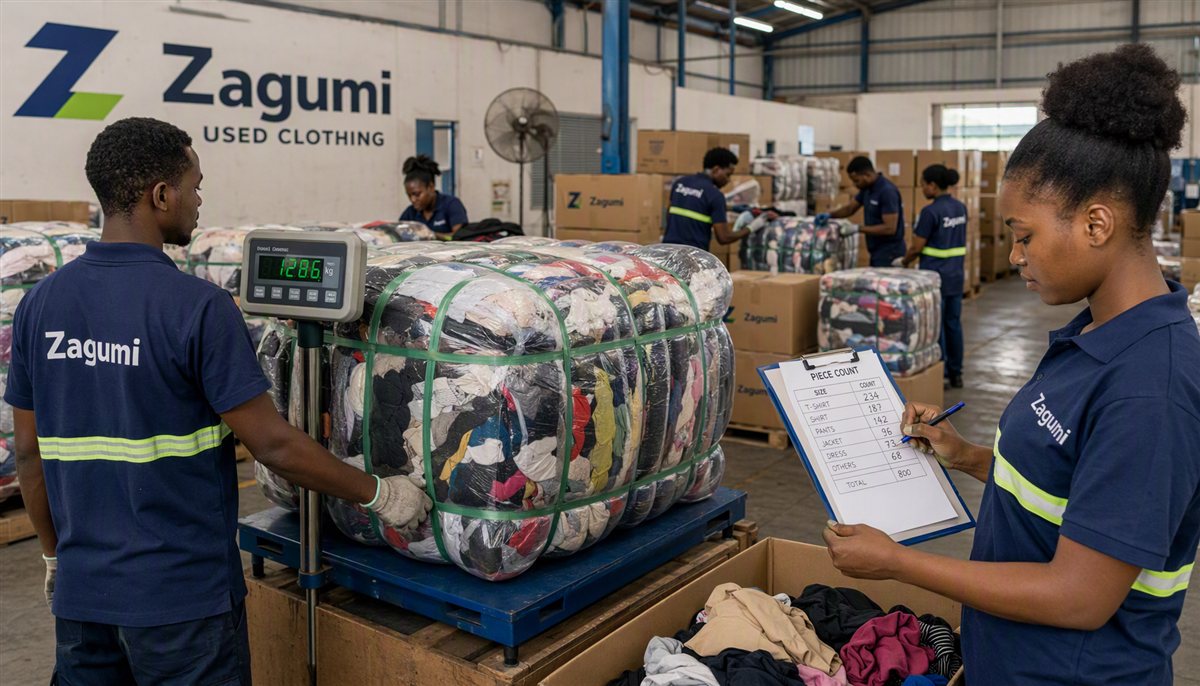
A profitable seasonal bale program depends on revenue per bale, not on price per bale or weight per bale. The useful calculation compares selling value against total cost for each season.
Revenue per bale = Sellable pieces × average selling price − total landed cost per bale
Sellable pieces should exclude items that cannot be sold at the planned price. Total landed cost includes the bale price, freight, port charges, local handling, and sorting labor.
| Bale type | Price per bale | Sellable pieces | Average selling price | Estimated revenue |
|---|---|---|---|---|
| Summer bales | $30 | 95 | $2.80 | $266 |
| Light denim bales | $38 | 52 | $4.50 | $234 |
| Winter sweater bales | $45 | 38 | $6.00 | $228 |
| Jacket and coat bales | $52 | 24 | $9.50 | $228 |
The numbers above are illustrative. They show why a bale with a lower price per kilogram can produce more revenue than a heavier, more expensive bale when turnover and selling price are included.
A wholesaler in Ecuador tracked revenue per bale for one season and found that light denim produced the best margin because it combined good selling price with moderate weight and consistent demand. Sweater bales were profitable but slower, tying up cash during the warm months. The next order increased denim and reduced the heavy share.
The same logic applies at the container level. If the order will be imported by the container, the total plan should be built from the per-bale revenue assumptions, not from the container price alone.
Action steps
- Track revenue per bale by season and category.
- Use realistic local selling prices, not international list prices.
- Apply a conservative sellable-rate assumption.
- Reduce categories with high weight and slow turnover.
- Plan the container mix from per-bale revenue, not the other way around.
6. Verify the Supplier’s Season Sorting and Quality Control
Season sorting is a process, not a claim. The buyer should verify that the bulk second hand clothes supplier can separate summer and winter items consistently and label the bales correctly before loading.
A realistic verification checklist:
- Video of the sorting line showing season separation.
- Opened-bale video showing the middle of the bale.
- Photos of winter and summer bales from the same production batch.
- A packing list that shows season ratio, category, weight, and piece count.
- Bale labels that match the packing list.
- Loading photos and the container seal number.
Zagumi reports that it operates a 20,000-square-meter factory with five inspection rounds and workers who have more than five years of practical experience. This is company information. Buyers should still verify how season sorting and grade checks apply to their specific order.
A buyer in Chile once accepted a video tour without asking to see bales from the actual production batch. The shipment was not mislabeled, but the season ratio leaned more winter than expected. The issue was verification, not fraud: the buyer had not confirmed the ratio against the packing list before loading.
The strict quality control description from Zagumi can be reviewed as part of supplier due diligence. It should be compared with an order-specific checklist rather than treated as proof that every bale meets the buyer’s standard.
Action steps
- Request dated photos and video from your production batch.
- Approve a sample bale before the full order.
- Check bale labels against the packing list.
- Use a third-party inspection for high-value orders.
7. Container Planning and Repeat Orders for Seasonal Wholesale
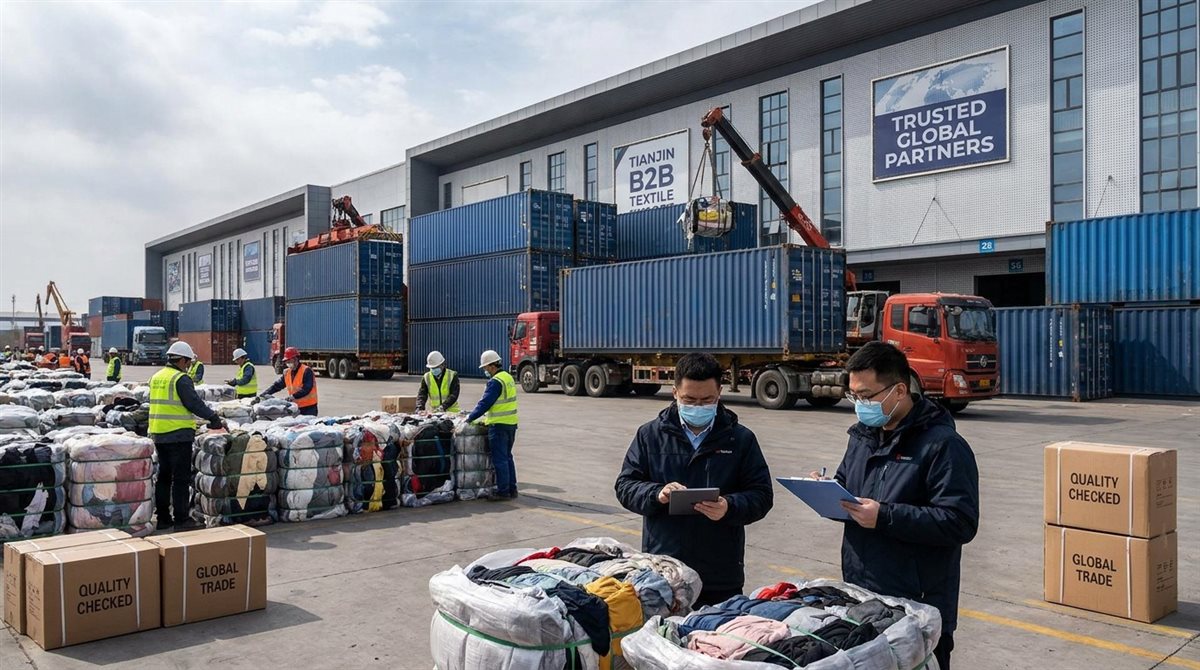
For buyers preparing used clothing bales for export, the container plan should match the destination selling calendar. Seasonal bales are usually shipped by the container, and the container plan should reflect the market’s selling calendar. A 20-foot container works well for a first test or a single-season program. A 40-foot container offers better volume economics but increases the risk of holding the wrong season mix.
Zagumi’s stated container ranges for mixed non-branded clothes are $23,000–$25,000 for a 20-foot container and $45,000–$50,000 for a 40-foot container. Branded clothes are listed higher, at $60,000–$80,000 for a 20-foot container and about $150,000 for a 40-foot container. These are company figures, not universal market prices, and the current quotation should be verified with the supplier.
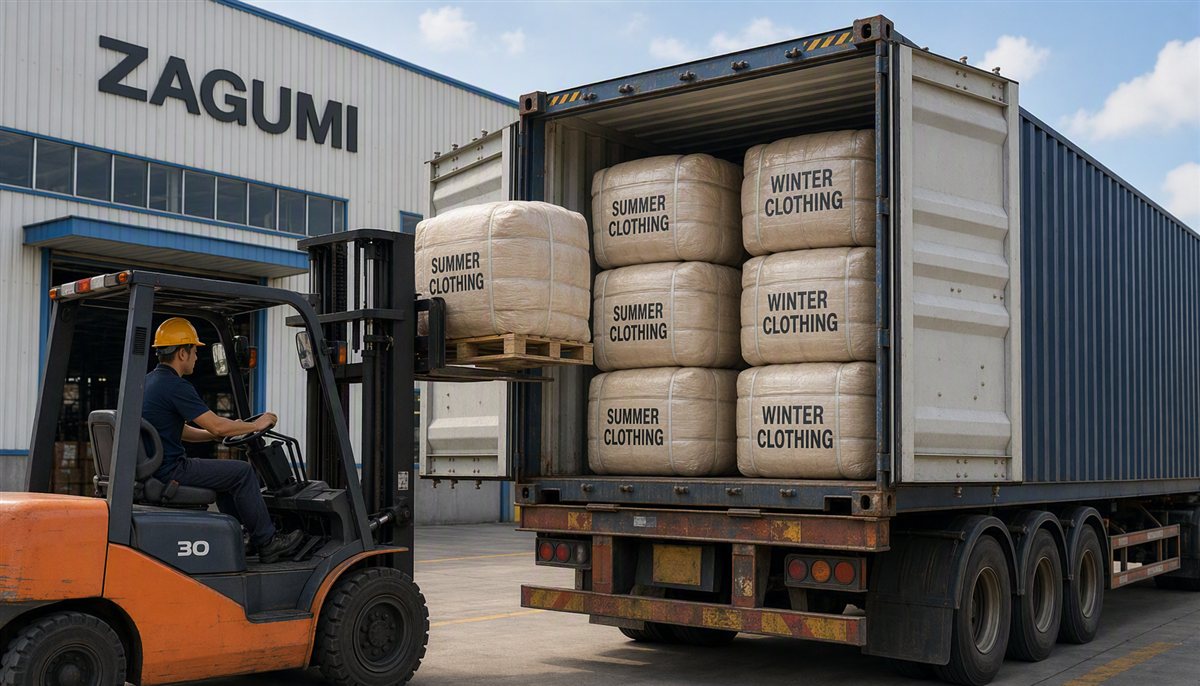
The season mix should be defined before the container price is negotiated. A buyer negotiating a good container price for the wrong season balance has still made a bad purchase.
Repeat orders work best when the season data is measured. Record sell-through by season, days in inventory, and unsold stock after every shipment, then adjust the next container. A supplier’s sorting quality can improve or decline, and only measurement reveals the difference.
If the buyer also trades shoes, shoes should be planned as a separate program with separate packing standards. Zagumi reports shoe figures of 1,000,000 pairs per month, 20+ brand subcategories, and about 60% Nike and Adidas, with standards such as 35 pairs of men’s shoes per 25 kilograms. These are shoe figures, not clothing figures, and should not be transferred to bale planning.
The supply chain system information from Zagumi explains how the company organizes sourcing and shipment coordination. Buyers can also compare the used brand clothes supplier in China information for branded apparel sourcing, and explore used branded shoes if footwear is part of the plan. For a general overview of supplier capabilities, visit the Zagumi website before comparing offers.
Action steps
- Plan the container mix around the selling calendar.
- Verify the season ratio before the price is finalized.
- Measure sell-through by season after every order.
- Keep clothing and shoe programs separate.
- Adjust the next container using your own sales data.
Conclusion
Bulk second hand summer and winter clothing bales are a strong sourcing option when the season balance, the market climate, the weight-to-piece ratio, and the revenue per bale are all planned in advance. The risk in seasonal bales is not usually poor quality; it is the wrong season mix arriving at the wrong time.
Buyers should define the ratio in writing, match it to the local selling calendar, verify the supplier’s sorting process, and measure results after every shipment. For buyers managing used clothing bales for export, the same discipline applies from the first bale to the repeat container. Zagumi’s company data provides a starting point, but responsible buyers connect any published claim to an order-specific specification and inspection plan.
The reliable seasonal formula is:
Written season ratio + market-matched timing + verified sorting + measured revenue per bale = profitable seasonal sourcing
FAQ
1. What ratio of summer to winter clothing should I order?
The ratio depends on your market climate, season length, and sales data. A warm year-round market may use 80% summer and 20% light winter, while a cold market may reverse that. Use your own selling records rather than a generic regional assumption.
2. Are winter bales heavier than summer bales?
Yes. Sweaters, jackets, and heavy denim weigh much more per piece than summer tops, so a winter bale holds fewer pieces per kilogram. This is why the season ratio should be defined by both weight and piece count.
3. Can I order mixed season clothing bales?
Yes. Mixed season bales combine a controlled share of summer and winter clothing. The key is to define the ratio in writing and confirm whether it is measured by weight, by piece, or by bale count before ordering.
4. How much does a container of seasonal used clothing cost?
Zagumi’s stated range for mixed non-branded clothes is $23,000–$25,000 for a 20-foot container and $45,000–$50,000 for a 40-foot container. Branded clothes are listed at higher levels. Prices vary by category, season, quality, and market, so verify the current quotation with the supplier.
5. How do I find a bulk second hand clothes supplier for seasonal bales?
Look for a supplier whose sorting line you can verify, whose season ratio you can approve in writing, and whose packing list shows both weight and piece count. Review the strict quality control approach and request opened-bale evidence before your first order.
6. Should my first order be summer, winter, or mixed?
A first order should match the strongest selling season in your market and keep the program simple. If your market has a clear warm season, start with summer used clothing bales wholesale. If you need flexibility, a small mixed order with a written ratio is a reasonable test.
7. How do I plan used clothing bales for export with a repeat supplier?
Record sell-through by season, days in inventory, and unsold stock after each shipment. Adjust the next order’s season ratio and category mix using that data, and keep clothing and footwear programs separate with their own packing standards.